
How 24/7 Warehouses and Logistics Companies in NYC Are Feeding Their Night Crews
Vending and micro markets built for NYC warehouses and logistics hubs. What hot food, coffee, and 24/7 access actually look like — and what it costs.
Vivian C.
5 min read
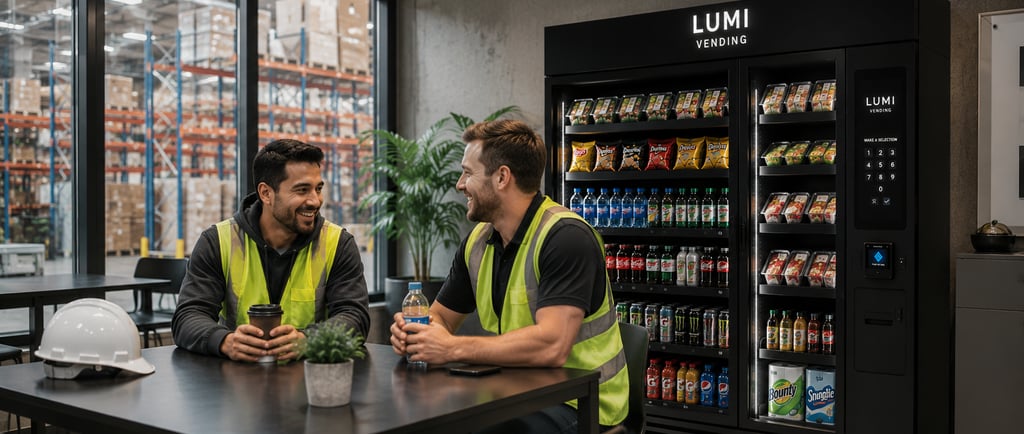
It's 9pm in a Queens logistics warehouse. The day shift left hours ago. The dock crew is mid-load. The nearest deli closed at 2pm. The next-closest 24-hour spot is 1.2 miles away — too far for a 15-minute break, too inconvenient to drive to in the middle of a shift. The fridge has someone's leftovers from last week and three half-empty bottles of seltzer.
This is the reality at hundreds of NYC warehouses, fulfillment centers, last-mile logistics hubs, and 24/7 operations. And it's one of the clearest places where a properly set up micro market changes everything — not just for food access, but for retention, productivity, and how workers feel about the company.
This guide is for warehouse and logistics operations managers, HR leaders, and facility decision-makers in NYC. It's written by a Queens-based operator placing micro markets and vending across all five boroughs.
Why warehouses are one of the strongest fits for micro markets in NYC
Three factors stack on top of each other:
1. Continuous demand from the workforce
A 24/7 warehouse never stops needing food and drinks. Coffee at 4am, energy drinks at noon, hot food at 8pm, snacks at midnight. Shift workers don't have the same eat-on-the-way-in pattern as 9-to-5 office workers — they need access to food and coffee across every part of the day.
2. Limited alternatives nearby
Most NYC warehouses are in industrial zones (Maspeth, Long Island City, Red Hook, Hunts Point, Sunset Park, Howard Beach) where retail food options are sparse and close early. The closest deli often shuts by 2pm. That makes the on-site option not just convenient but essential — especially for the second-shift crew who arrive after the local food options have closed.
3. A setup that earns its place
A well-fitted warehouse micro market gets used. Shift workers rely on it, repeat use becomes daily routine, and the breakroom turns into a real amenity instead of a vending corner. That sustained, everyday use is what makes the placement model work for both the operator and the host — without the operator needing to bill the host for any of it.
What a proper warehouse setup looks like
Phase 1: launch in 30 days
Open shelving for snacks, chips, pretzels, candy, jerky, protein bars
Smart refrigerated cooler for sodas, energy drinks, water, sports drinks, dairy
Second cooler for cold prepared items: sandwiches, wraps, salads, fruit cups
Bean-to-cup coffee machine for $2 regular coffee and $2.50-3.50 specialty
Self-checkout kiosk: tap to pay, card, mobile
Two security cameras covering shelving and the checkout area
Signage: prices, payment instructions, restock schedule
Phase 2: hot food integration (60-90 days post-launch)
Hot food vending machine with built-in heating system (items stored cold, heated on demand at purchase)
Commissary partnership for refrigerated fresh inventory delivered 2-3 times per week
Expanded menu: breakfast sandwiches, hot wraps, soups, hot entrées — heated to order at the machine
Multi-day shelf life means consistent quality across every shift, not just right after delivery
How heat-on-demand vending actually works
Modern hot food vending machines store items at refrigerated temperatures and heat each one on demand when a customer makes a purchase. The heating cycle — typically 30 to 60 seconds, depending on the item — happens inside the machine before the door releases.
This is meaningfully different from a heated display case, where prepared food sits at temperature for hours waiting to be bought. With heat-on-demand:
Items maintain quality across an entire shift cycle, not just for the first hour after delivery
Refrigerated inventory has a multi-day shelf life, so commissary delivery runs 2-3 times per week instead of daily
There's no holding-temperature window for items to dry out, get soggy, or fail a food safety check
A worker arriving at 3am gets the same sandwich quality as one arriving at 8am
For 24/7 NYC warehouses where shifts overlap and demand is unpredictable, heat-on-demand is almost always the better fit. Heated display cases work well in higher-volume daytime locations (large office cafeterias, hospital staff lounges) where items move quickly enough that holding temperature is a non-issue.
NYC pricing benchmarks for warehouse micro markets
These are typical NYC warehouse micro market prices, benchmarked against local bodega pricing:
Common warehouse-specific questions
Our facility runs 24/7 with no breakroom supervision. Will theft be a problem?
Less than you'd expect. Self-checkout kiosks require a registered payment method, security cameras cover the floor, and shrinkage in NYC warehouse micro markets typically runs 1-3% — comparable to bodega loss and far below what most managers expect.
We already have a Coke machine on-site. Can a micro market still work?
Yes. The existing Coke machine handles soda; the micro market handles everything the Coke machine doesn't — coffee, snacks, hot food, fresh items, water. They work alongside each other. This is a common setup at Queens logistics hubs.
Our breakroom is being renovated. When should we plan the micro market?
Coordinate with your contractor. Most setups need: 4-6 standard outlets, sufficient floor space (80-150 sq ft), no plumbing required for most coffee machines, and clear sightlines for cameras. Lumi typically does a pre-renovation site visit to confirm spec.
What about hot food at 2am? Is that realistic?
Yes. Hot food vending machines store items cold and heat them on demand when a customer purchases — typically a 30 to 60 second cycle built right into the machine. Sandwiches, wraps, entrées, and soups can sit refrigerated for several days and come out hot the moment they're ordered. This is a better fit for 24/7 warehouses than a heated holding case, because items aren't sitting at temperature losing quality between shifts. NYC commissary partners deliver fresh inventory on a multi-day cycle and the machine handles the rest.
Pricing benchmarks, equipment costs, and operational details in this guide reflect NYC market conditions in 2026 and may shift with inflation, commissary pricing, energy rates, and supply chain changes. Setups described are general industry approaches — every warehouse has its own layout, schedule, and workforce considerations that affect what works. Lumi Vending walks through specifics on-site before any placement.
Running a warehouse, fulfillment center, or 24/7 logistics operation in NYC? Lumi Vending designs micro markets specifically for shift workers, dock crews, and overnight operations. Site visits include a tape measure, sample basket, and direct, no-pressure walkthrough. Request a warehouse consultation.
What hosts actually get from this arrangement
When a properly set-up warehouse micro market is in place, the value for the host shows up in places that don't appear on a financial statement — but matter:
A breakroom workers actually want to be in. Worn-out vending corners become real amenities. That changes how the space feels and how the crew talks about the company.
Less time lost to off-property runs. When the food and coffee are 30 seconds from the dock, breaks stay onsite and shifts stay on schedule.
A retention signal the workforce sees every shift. "There's nothing to eat here" stops being a complaint. That's a small thing that compounds, especially in industries where shift workers compare employers.
Zero operational overhead. The host doesn't stock, restock, manage cash, handle complaints, or repair equipment. The operator handles all of it.
No invoice. Equipment, setup, stocking, kiosk software, security, and maintenance are all on the operator. The host's cost is electricity and a corner of the breakroom.
That's the deal: the operator earns sustainable margin from steady, everyday transactions; the host gets a workforce amenity that costs them nothing to run. Neither side is doing the other a favor.
What changes when warehouses get micro markets (beyond food)
Less time off-property
When workers don't need to drive 15-30 minutes to a deli or fast-food spot for a snack or coffee, breaks stay onsite. Operations managers commonly report 10-15 minutes per worker per break saved on travel, which adds up significantly across a mid-size warehouse crew.
Better retention signal
"There's nothing to eat" is one of the most-cited frustrations from warehouse workers in NYC industrial neighborhoods. A well-stocked micro market is one of the cheapest, most visible benefits an employer can add — and it's visible every single shift.
Lower absenteeism risk on bad-weather days
When the nearest deli is a 10-block walk in February rain, an on-site food option keeps the shift moving. Small thing, real impact.
A reason to stay during overtime
Late shifts and unexpected overtime are easier to staff when workers know they don't have to skip dinner.
© 2026 LUMI VENDING
Lumi Vending — Where Convenience Meets Choice.
Based in Queens. Serving all of NYC.