
Vending Machine vs. Micro Market: Which One Fits a Small NYC Business?
Vending machine or micro market for your NYC office or warehouse? Headcount thresholds, costs, and a 5-question framework to choose the right one.
Vivian C.
4 min read
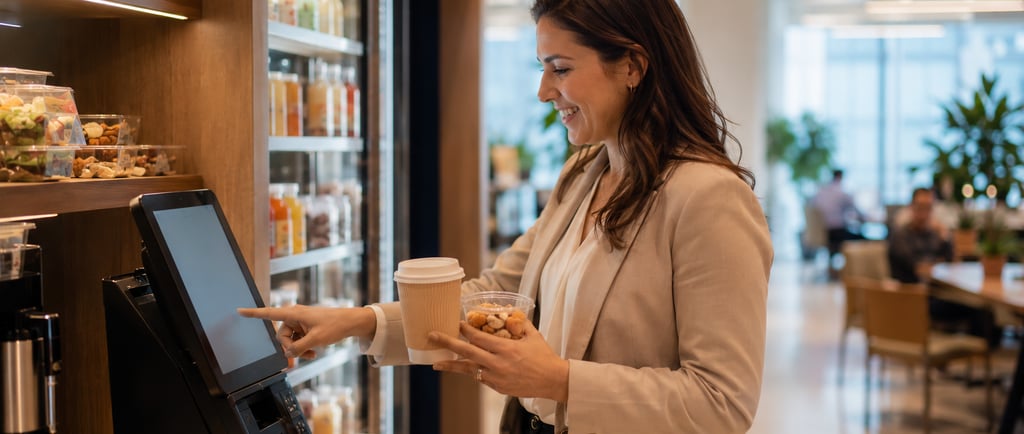
If you're running a 30 to 200-person operation in New York City and your team is constantly running out for snacks, coffee, or lunch, you've probably been pitched both a vending machine and a "micro market." They sound similar. They're not. Picking the wrong one wastes space, frustrates your team, and locks you into a setup that doesn't match how your people buy food.
This guide explains the differences, the headcount thresholds where each one makes sense, and a simple framework for choosing — written specifically for NYC small and mid-size businesses.
Quick definitions
Vending machine
A self-contained, locked unit that dispenses snacks, drinks, or both through a spiral, conveyor, or robotic mechanism. Customers pay at the machine (card, tap, or app) and a single item drops. One machine, one transaction at a time, fixed product slots.
Micro market
An open, unattended retail setup. Customers grab whatever they want — bottles, snacks, sandwiches, fresh items, hot drinks — and check out at a self-service kiosk. Multiple items per transaction. Refrigerated coolers, open shelving, and (often) a coffee machine all share one checkout.
Side-by-side comparison
Forget national averages. Here's what works in New York City specifically, where foot traffic is denser and price tolerance is higher than most U.S. markets:
Under 50 daily users: one vending machine
A single combo machine (snacks on top, drinks on bottom) is almost always the right call. A micro market at this size would be oversized for the workforce — too much equipment and floor space relative to actual daily use.
50 to 100 daily users: vending or hybrid
This is the gray zone. A 75-person Queens office that mostly works 9-5 may do fine with two machines. The same headcount with a 24/7 shift schedule, multiple breaks, or a culture of long days warrants a small hybrid micro market with open shelving, one cooler, and a kiosk.
100 to 200 daily users: hybrid micro market
This is the sweet spot for Lumi's hybrid model. Open shelving and smart coolers handle snacks and drinks; a Cantaloupe kiosk handles checkout; a bean-to-cup coffee machine handles coffee; and an optional hot food vending machine adds heated meals on demand. At this scale, the transaction volume comfortably supports the free-placement model for both sides.
200+ daily users: full micro market
Full micro markets with multiple coolers, fresh food refresh 3-5 times per week, hot food integration, and possibly an espresso machine. At this scale, the location effectively becomes a small unattended convenience store.
NYC headcount thresholds that matter
Where vending machines win in NYC
Lobbies of residential buildings (lower traffic, security matters, theft risk needs to be near zero)
Laundry rooms, mailrooms, gym corners — anywhere with constant but unpredictable traffic
Schools and senior centers where item-level control and accountability are critical
Auto shops, small warehouses, and shift workplaces where the budget is for one quick item
24/7 buildings where supervision is impossible and locking the inventory matters
Where micro markets win in NYC
Office breakrooms where employees eat lunch on-site
Warehouses and logistics hubs with shift workers who buy multiple items per trip
Gyms with members who want a smoothie + protein bar + electrolyte drink in one transaction
Hotels with guest demand for breakfast items, water, snacks, and small meals
Nonprofits and large workplaces serving lunch to employees who want fresh food, not just snacks
The decision framework: 5 questions to answer in order
1. How many people use the space daily?
Under 50: vending. 50-100: gray zone, depends on hours. 100+: lean micro market.
2. What's the operating schedule?
9-5, Monday-Friday: vending often sufficient. 24/7 or multi-shift: micro market almost always wins. A 24/7 warehouse with 150+ users and no nearby late-night food options is a textbook example — when the closest deli closes at 2pm, on-site becomes essential, not optional.
3. Is there space available?
If you don't have 80-150 sq ft of contiguous space, a micro market isn't physically possible. A vending machine is.
4. Do you want fresh and hot food?
If yes, you need a micro market with a permitted NYC commissary partner supplying fresh items, plus either a hot food vending machine or heated case for warmed meals. Standalone vending can't deliver a full lunch experience in NYC.
5. What's the host's tolerance for shrinkage?
Vending: near-zero loss. Micro market: 1-3% shrinkage is normal with cameras and kiosk monitoring. Most NYC employers accept this; some (especially logistics and security-sensitive operations) prefer locked machines.
What the hybrid approach looks like
Most of Lumi's NYC placements at 100-200 daily users use a hybrid setup:
Open shelving for ambient snacks, candy, chips, and shelf-stable items
One or two smart refrigerated coolers for beverages, dairy, fresh items
Bean-to-cup coffee machine for $2-3 specialty coffee
Self-checkout kiosk for tap-and-go payment
Security cameras for shrinkage management
Optional Phase 2: hot food vending machine with commissary-supplied items (heated to order at the machine)
This setup fits in roughly 100 square feet and serves a workforce that would otherwise need to leave the building or go without food. Equipment, software, installation, stocking, and service are all operator-provided.
Frequently asked questions
Can a small business in NYC get a micro market for free?
If the daily user count supports it (usually 75+), yes. The operator covers equipment, installation, stocking, kiosk software, and security. Host provides space, electricity, and (sometimes) a Wi-Fi connection.
What stops people from stealing in an unattended micro market?
Three things: security cameras, the social proof of coworkers around, and the fact that everyone has a registered payment method at the kiosk. NYC micro markets typically run 1-3% shrinkage — comparable to a small bodega and far below what most people expect.
What if our team is under 50 people now but will grow?
Start with a vending machine, agree on a micro market upgrade threshold in writing (usually 75-100 daily users), and let the operator handle the transition when you cross it. This is one of the most common Lumi placement patterns in NYC startups.
Do micro markets need plumbing or electrical work?
Usually no. Coolers and the kiosk plug into standard 110V outlets. Bean-to-cup coffee machines either plumb into an existing water line or use a refillable tank. A typical NYC breakroom already has the power and water needed.
Pricing, equipment costs, and headcount thresholds in this guide reflect NYC market conditions in 2026. The right setup for any specific location depends on factors beyond headcount alone — space, hours, workforce makeup, and existing food options all matter. Lumi Vending offers a free walkthrough to assess your specific situation
Not sure if vending or a micro market fits your NYC location? Lumi Vending offers a free 15-minute walkthrough — virtual or in-person — to assess your headcount, space, and schedule. We'll tell you straight up which option fits, and what it would look like. Book a walkthrough.
© 2026 LUMI VENDING
Lumi Vending — Where Convenience Meets Choice.
Based in Queens. Serving all of NYC.